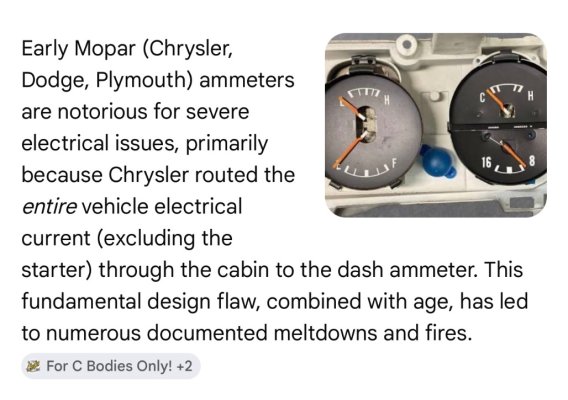
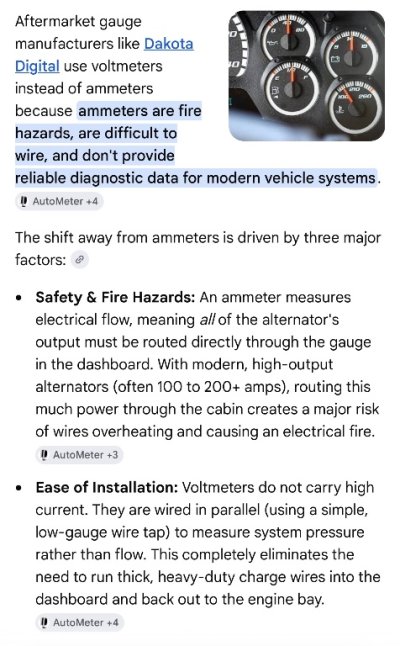
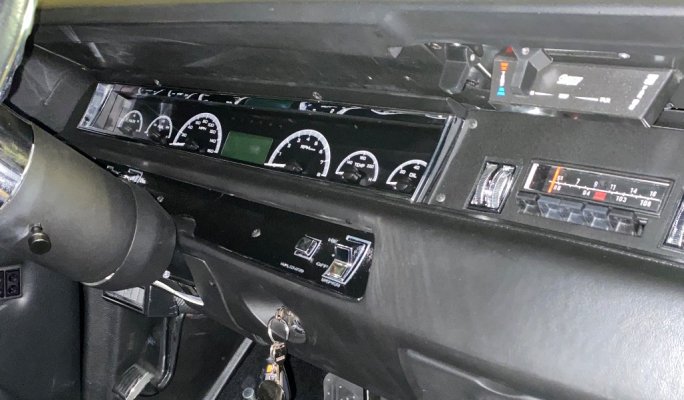
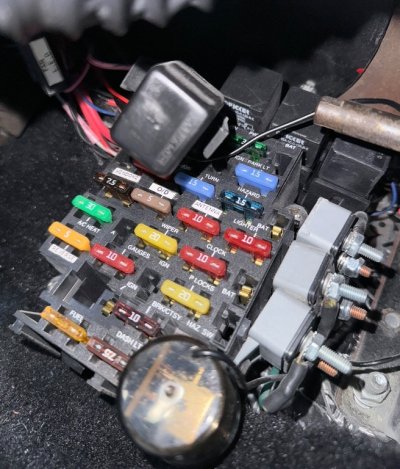
Old school (outdated) amp meters are wired in parallel with direct wiring from the alternator passing through the firewall to the amp meter and back through the fire wall thereby carrying the full electrical load of the entire electrical system. When extra updated components are added like AC and high output sound system, extreme stress is placed on the weak link in the system (the amp meter)! Where short circuits (and fires) occur… typically where the wire passes through the firewall. A volt meter, on the other hand, is wired in series thereby carrying very minimal load with virtually little to no chance of it causing a dangerous situation. Amp meters and volt meters are apples and oranges… completely different technology. The only purpose for both is to insure the battery output is where it should be at any given time while driving.
You must be stating your opinion once more, that description of how this system works is not factual at all. Facts are, as originally designed, all stock, no modifications, everything healthy and operating normally,
all vehicle running loads do not flow through the ammeter while the vehicle is in operation, needle centered indicating little to no current through the ammeter while in operation. All factory running loads are on the alternator side of the ammeter, at the main dash harness splice, alternator is providing that current, not the battery. Only current flowing through ammeter while in operation is battery charging current, very little with a heathy fully charged battery. In fact, the ammeter is wired in series between the battery on one side and all stock running loads and the alternator on the other side of the ammeter. Only with misplaced added vehicle running loads at the battery or starter relay (or anywhere battery side of the ammeter) will running load current flow through the ammeter while in operation. Fact is, all current drawn by any and all non-factory added loading (all the race car stuff, MSD, cooling fans, lights, amplifiers, fuel pumps) connected on the battery side of the ammeter will current stress the ammeter by placing the stock ammeter, and all related connections well out-side their originall design current limits. Load placement matters for this all-stock Chrysler electrical system.
More facts, the Packard terminations in the charge path at the bulkhead connector are by far the weakest link in this ammeter-based charging system, always have been. More factory electrical options will place more current stress on the one set of Packards in the wire run from the alternator to the main splice but has nothing to do with the ammeter, it is the load distribution for the entire vehicle. Bypassing the ammeter by connecting its dash harness leads together changes nothing for the Packards in the bulkhead connector, will still have be over-stressing those connections with misplaced loading.
And yes, there is a ton of misinformation circulating about these ammeters and how they were designed to function in this system, a lot of opinions short on facts. The designed function of this system is described in detail in all factory service manuals from the time, as well as all factory dealer tech training materials on the subject, Google that.



 After returning home from Vietnam in late 67 I ended up a team member of the Apollo Program as a senior design engineer. One of my designs was responsible for the first moon landing going without a hitch!! At that time I was also designing and building “pro-stock” dragons racing cars (all Mopars) and even back then all the poorly designed electrical “spaghetti” was removed and replaced with advanced (for the time) technology… for safety and reliability. My original 69 Road Runner caught on fire (under the dash) while racing at Orange County Raceway in 1970. That’s when I dumped the hazardous poorly designed wiring for a much advanced safe system and never had any problems after that. You are likely too young to recall all the under dash issues back in the day. I lived it and saw a lot. Everyone has an opinion. I’m not knocking your opinion. Just sharing some “actual” experiences and what I learned from those experiences. I personally know quite a few oldies (like me) that have had the same experiences. Have fun with your cars and be sure to keep a close eye on anything abnormal under the dash

 And I can only speak for myself but I don`t see or anyone getting "up in harms".